


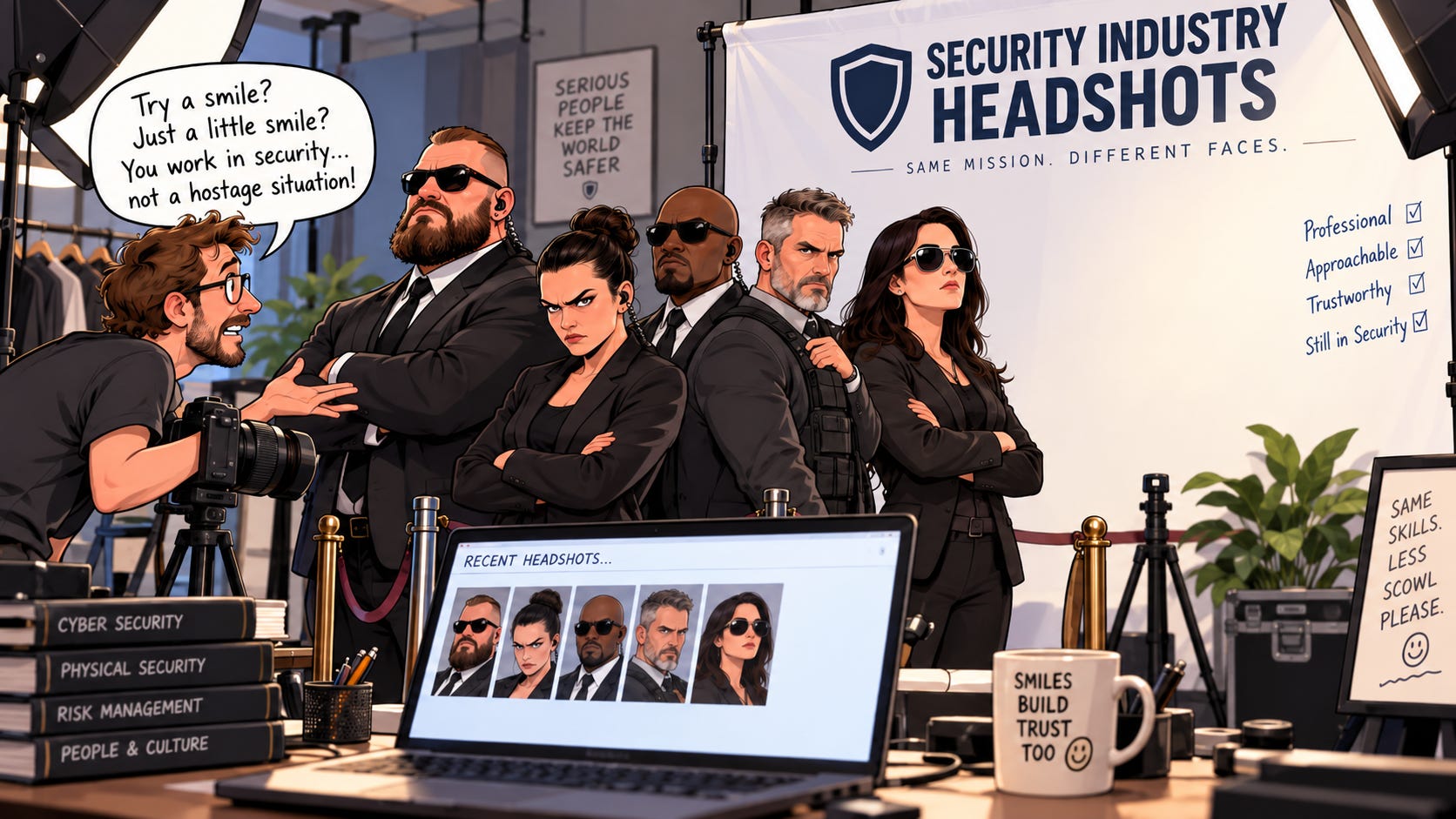
Have you noticed how few security professionals smile in their profile pictures? Looking intimidating doesn’t make you a competent security risk management professional.
Scroll through LinkedIn or visit a few security consulting websites. You’ll encounter an impressive collection of crossed arms, clenched jaws, dark sunglasses, and expressions that suggest someone just received exceptionally bad intelligence.
Looking like you’re preparing to interrogate someone or kick their ass doesn’t make you a security professional, and it probably won’t get you a role in an action movie either.
The Theater of Toughness
The security industry has developed a comical obsession with projecting authority.
Consider the typical profile photograph. Dark suit. Stern expression. Arms crossed.
Bonus points for tactical vehicles, earpieces, badges, or a command center that looks like it belongs in a James Bond movie.
The message is unmistakable:
I’m serious. I’ve seen terrible things. Things you couldn’t possibly understand. Fortunately, I’m here to protect you, your family, and your pets…
This imagery is particularly popular among professionals with law enforcement, intelligence, military, or counterterrorism backgrounds.
Those backgrounds can provide a valuable foundation, but neither a badge nor a strategically positioned windbreaker, along with a frown, establishes competence.
Looking intimidating says nothing about their ability to assess vulnerabilities, evaluate the commercial consequences, prevent incidents, reduce liability, develop mitigation strategies, or make sound risk management decisions.
You might look like a DELTA Force commando and still be completely lost when conducting a physical risk assessment on a commercial site or a private estate. But even with your best efforts, if a gunfight erupts or things need to be blown up on your site, they may be of some value, assuming the “look” is legitimate.
Security Theater Comes to Social Media Profiles
I’ve written about security theater before: creating the appearance of security without reducing risk. Tactical glamour shots should be near the top of the list.
We already have expensive uniforms, unnecessary tactical equipment, a shiny, police-looking SUV (usually one) with a push bar, and elaborate technology solutions masquerading as meaningful security improvements. And, of course, sunglasses.
But do we really need or want consultants posing as if they’re about to raid a terrorist compound?
The appearance of tactical proficiency is not evidence of competence in security risk management.
What Are We Actually Selling?
Physical security isn’t meant to convince everyone that civilization is about to collapse. In most cases, it should be understated and blend in with the site. It’s there to give people confidence that foreseeable risks are being managed appropriately, so they can live, work, conduct business, and enjoy their lives.
Security should inspire confidence, not manufacture anxiety.
That doesn’t mean minimizing threats. It means understanding them, communicating honestly, and recommending practical solutions.
Unfortunately, fear sells. And nothing reinforces fear quite like hiring someone whose professional photograph suggests he’s personally disappointed he’s not in a gunfight, if he ever was.
Serious Work Doesn’t Require a Scowl

I’ve spent much of my career in environments where failing to manage physical security could have catastrophic consequences.
From military aviation to corporate risk management and complex international operations, I’ve seen firsthand the importance of preparation, discipline, judgment, and genuine expertise.
But I cannot recall a single security problem being solved by a scowl on someone’s face. Nor have I ever seen a risk assessment improved because of crossed arms or tactical sunglasses.
Approachability can be a significant professional advantage. To conduct a thorough risk assessment, we rely on employees, managers, contractors, and others to share candid information about vulnerabilities, incidents, and operational realities.
Who will get better information? The professional who listens, asks thoughtful questions, and puts people at ease? Or the guy who looks like he’s about to demand everyone’s identification?
People open up when they feel respected, not interrogated.
Security Definitely Has a Branding Problem
Security professionals frequently complain that executives don’t take the industry seriously. Perhaps we should consider how we present ourselves.
If we want to be regarded as sophisticated business advisors, we should demonstrate expertise in operations, finance, technology, governance, and risk – not just kicking ass.
We should provide thoughtful analysis, defensible recommendations, and measurable results.
And perhaps look like someone who belongs at the table, not someone who looks like he intends to smash it with his head.
It’s time to retire the tactical glamour shots, crossed arms poses, and expressions of perpetual outrage.
Try to look approachable. Try to look confident and competent. Try to look like you enjoy helping people.
You might even try smiling.
S6RG | Strategic Physical Risk & Resilience Solutions
Independent. Objective. Practical. Defensible.