


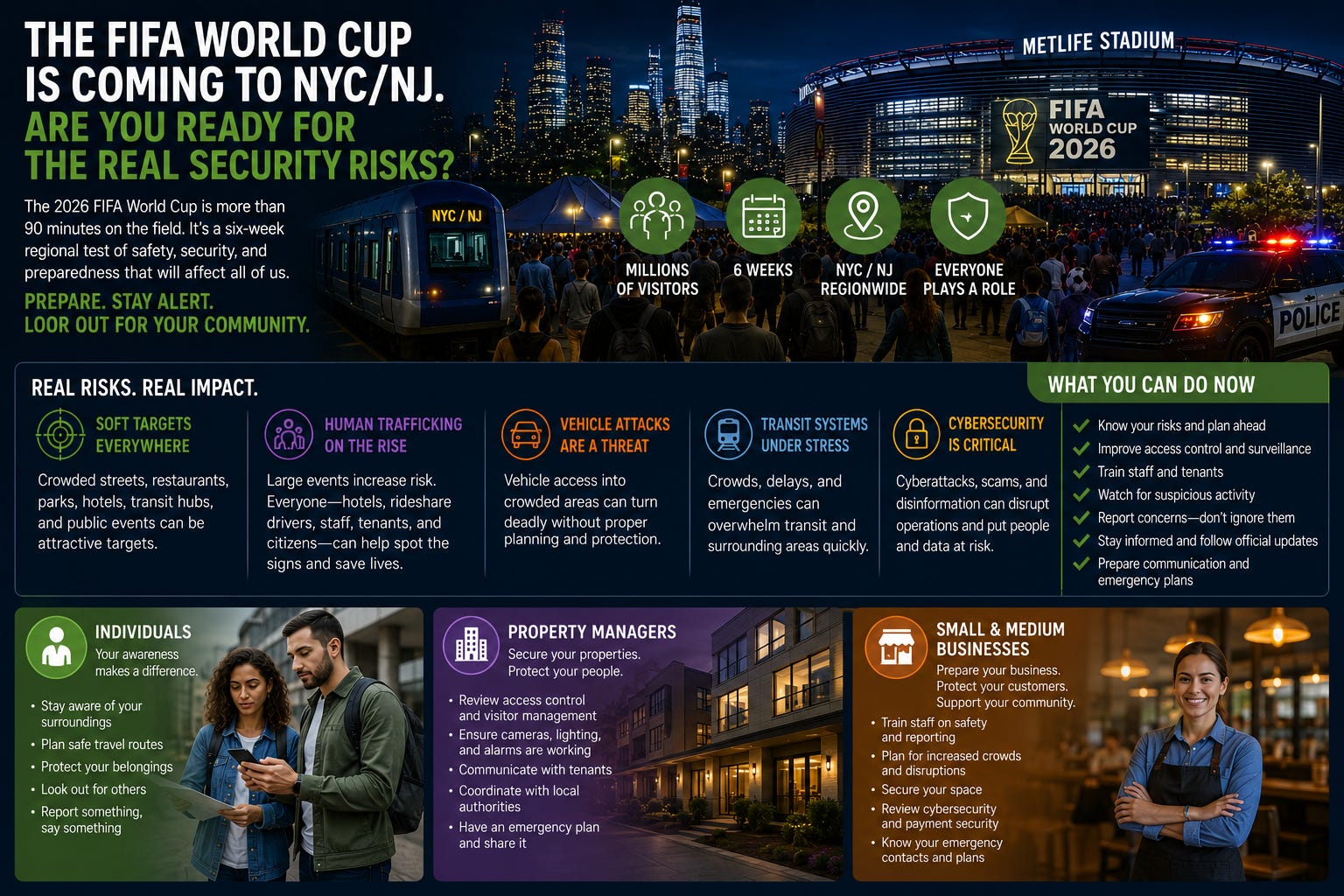
When most people think about security for the 2026 FIFA World Cup, they picture the stadium. Metal detectors. Tactical teams. K-9 units. Bag checks. Police lines. Helicopters overhead.
But for communities, businesses, property owners, and individuals across New York and New Jersey, the greatest risks are not confined to a stadium’s perimeter. They are at train stations, outside bars, in crowded downtowns, at outdoor watch parties, in rideshare pickup zones, on closed streets, in parks, in hotels, at transit choke points, among overtaxed first responders, at overloaded dispatch centers, and even online.
The World Cup is more than a sporting event. It is a six-week regional stress test for public safety, infrastructure, emergency management, and personal preparedness.
The Security Footprint Extends Far Beyond MetLife Stadium
Yes, MetLife Stadium will host high-profile matches, including the final, under the global spotlight. However, the tournament’s operational footprint extends far beyond East Rutherford.
Every community connected to the region’s transportation system, hospitality industry, nightlife economy, or tourism ecosystem becomes part of the event, whether it wants to or not. That includes Jersey City, Hoboken, Newark, Secaucus, Elizabeth, New York City, and countless suburban downtowns across northern New Jersey, where visitors will gather to eat, drink, watch matches, and travel throughout the region.
Millions of people are expected to pass through the NYC/NJ area during the tournament. Many will never set foot in a stadium, yet they will still pose security challenges.
That means the security burden will not rest solely on governments or law enforcement.
Property managers, hotels, restaurants, retailers, office buildings, apartment complexes, transportation providers, and even ordinary residents will operate in an elevated-risk environment.
The Greatest Vulnerability May Be the “Soft Targets”
Modern stadiums are hardened environments. The areas surrounding them often are not. For global events like FIFA, the surrounding areas can extend for dozens of miles.
Outdoor dining districts, fan zones, public plazas, restaurant corridors, waterfront parks, temporary queuing areas, transit hubs, hotels, apartment buildings, and entertainment districts are attractive targets because they are crowded, difficult to secure, and often lightly protected.
Unfortunately, many organizations still rely on improvised security measures that were never designed for high-threat environments. Decorative barriers, temporary fencing, cones, lightweight barricades, and minimal staffing are often treated as sufficient simply because they create an appearance of control.
Small and medium-sized businesses should not assume they are “too small” to be affected. In many cases, opportunistic crime targets locations with the weakest security posture, not necessarily the highest profile.
Property managers should evaluate access control, visitor management, lighting, camera coverage, package security, emergency communications, and coordination with local police and emergency responders before the tournament begins. Restaurants and bars should prepare for crowd management, intoxicated patrons, disputes, theft, and surges in foot traffic. Retailers should anticipate increases in shoplifting, organized retail theft, fraud, and disruptive behavior.
Individuals and families should also rethink personal safety at large-scale events. Situational awareness and transportation plans matter. Knowing alternate routes, avoiding overcrowded areas when possible, and staying in contact with family members during major events can make a significant difference in an emergency.
Human Trafficking Will Also Be a Major Concern
Large international events do not just draw tourists and fans. They also attract organized crime.
Human trafficking has historically increased around major sporting events, conventions, festivals, and high-volume tourism periods because traffickers follow demand, anonymity, and opportunity. The sheer volume of visitors, hotel activity, rideshare traffic, nightlife, and temporary labor creates an environment where exploitation can be easier to hide in plain sight.
This is not just a law enforcement issue; it is a community issue.
Hotel staff, rideshare drivers, bartenders, restaurant workers, security personnel, property managers, transportation employees, healthcare workers, and ordinary citizens may encounter signs of trafficking without recognizing them.
The signs are often subtle.
A young person who appears fearful, withdrawn, or controlled by someone else. Individuals who avoid eye contact or seem unable to speak freely. Someone who appears coached or monitored while answering basic questions. Guests are rotating rapidly through hotel rooms. Excessive foot traffic to rooms at unusual hours. Minors accompanied by unrelated adults in suspicious circumstances. Individuals who appear malnourished, exhausted, injured, or deprived of personal possessions or identification.
Most importantly, trafficking victims often do not self-identify as such. Fear, coercion, debt, threats, addiction, immigration concerns, or psychological control often prevent them from seeking help.
That means awareness, training, and reporting are important.
Businesses and property owners should consider providing basic staff awareness training before the event begins so employees understand what suspicious activity may look like and how to report concerns safely and appropriately.
Vehicle Attacks Remain a Serious Concern
One of the most overlooked risks is hostile-vehicle mitigation. Many organizations still confuse traffic management with security, yet they are not the same.
A row of orange cones does not provide hostile-vehicle protection. Neither do decorative planters unless they are engineered, crash-rated, and properly installed. If not, they can actually become part of the threat.
Any location expecting large crowds — including restaurants, office campuses, apartment complexes, hotels, outdoor events, and downtown business districts — should assess vehicle access, pedestrian density, emergency vehicle routes, crowd egress patterns, and perimeter vulnerabilities.
Transit Systems Will Become Security Environments
The World Cup will depend heavily on regional transit infrastructure. That means train stations, bus terminals, rideshare zones, pedestrian bridges, and surrounding streets will become security zones — not just transportation hubs.
Crowd compression, delayed trains, heat emergencies, intoxicated patrons, aggressive behavior, medical incidents, and panic conditions can escalate quickly when tens of thousands of people move through confined spaces.
Individuals should anticipate delays, congestion, and communication challenges. Businesses should prepare for disruptions to employee commutes, delivery delays, and operational interruptions.
Cybersecurity Is Now a Public Safety Issue
Cybersecurity can no longer be treated as merely an IT issue.
Large international events create opportunities for ransomware attacks, phishing campaigns, fake emergency messages, fraudulent ticketing schemes, compromise of surveillance systems, and attacks on dispatch or traffic management systems.
Small businesses are often especially vulnerable because they may lack dedicated cybersecurity staff or incident-response plans.
Before the tournament begins, business owners should ensure software is up to date, enable multi-factor authentication, review backup procedures, educate employees about phishing, and verify emergency contact procedures.
Individuals should also remain cautious of ticket scams, fake event websites, fraudulent QR codes, fake rideshare accounts, and malicious public Wi-Fi networks.
Preparation Matters More Than Panic
The wrong question is “How do we secure the World Cup?” The better question is “How will the World Cup affect our people, property, operations, and daily routines?”
For municipalities, this means emergency planning and coordination. For property managers, this means assessing vulnerabilities before problems occur. For businesses, this means understanding operational and liability risks in a high-volume environment. For individuals and families, this means practicing awareness and preparedness without fear.
The 2026 FIFA World Cup will bring significant energy, economic activity, and international attention to the NYC/NJ region. It will also expose weaknesses. The organizations and individuals that perform best during large-scale events are usually not the ones with the biggest budgets. They are the ones who prepared before the crowds arrived.