


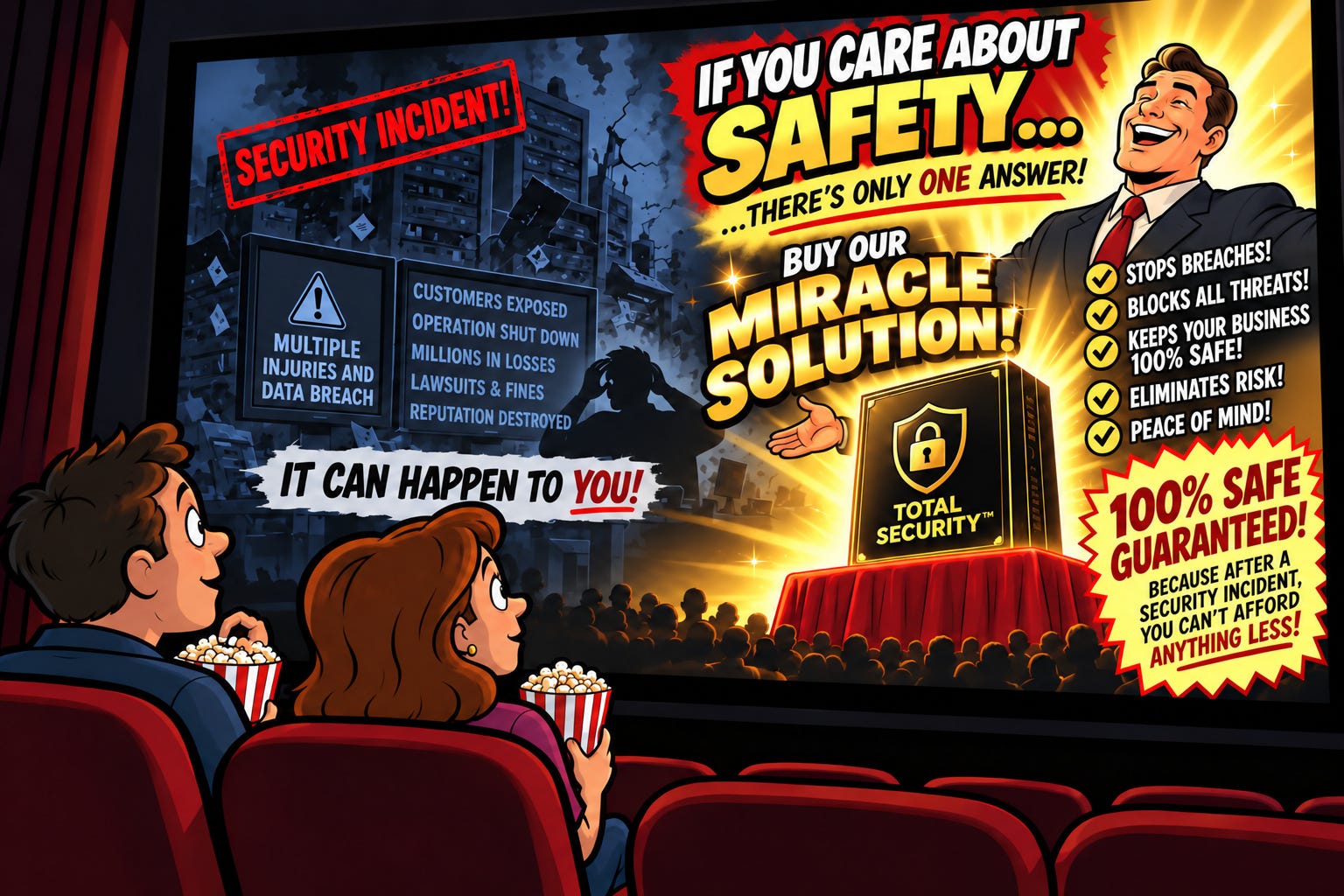
Something terrible happens. People panic. Executives demand answers. Politicians promise action. Then the security salesmen arrive with frightening statistics, colorful brochures, miracle technology, and promises that sound curiously like guarantees.
Don’t assess your risks. Don’t question the claims. Don’t waste time establishing requirements. Act now, before the special pricing expires. And remember, if you hesitate, perhaps you don’t really care about safety.
Artificial intelligence WILL detect every threat. Facial recognition WILL identify every criminal. Weapons detection WILL prevent the next tragedy—more cameras, more guards, more software, and maybe a few guns. Whatever the problem, someone has a product that WILL solve it.
Welcome to security theater.
Admission is free. The sequel, however, can be extraordinarily expensive. And the audience may not realize they’ve been watching a performance until something goes terribly wrong.
What Is Security Theater?
Security theater consists of measures that create the appearance of protection without meaningfully reducing risk.
Think cameras nobody monitors or responds to, armed guards with inadequate training, access controls routinely bypassed, and emergency notification systems never properly tested.
Another example is a so-called free security assessment that ultimately recommends purchasing expensive equipment from the same company providing the assessment.
Visible security isn’t inherently theater. Deterrence and reassurance have legitimate purposes. Nor is every ineffective measure dishonest.
The problem arises when appearance trumps effectiveness and is deliberately marketed as genuine protection.
Fear: The Perfect Sales Opportunity
Highly publicized tragedies often prompt immediate marketing efforts from some security vendors.
Following incidents such as school shootings or workplace attacks, vendors often market their technology as the missing solution, implying that its use could have prevented the tragedy.
This happens even when the vendor hasn’t investigated the incident, reviewed existing security measures, or determined whether their product would have made a difference.
Sales opportunities often take priority over a thorough review of the facts.
Then comes the emotional blackmail:
“If you really care about your employees…”
“Can you afford not to protect your children?”
“What will you tell the families if something happens?”
These statements are not risk-management arguments; they are emotional pressure tactics.
If declining to buy a product is equated with indifference to safety, you’re dealing with a salesperson rather than a qualified risk adviser.
The Consultant Who Is Really a Salesman
Some of the most problematic security theater is presented as professional consulting.
An organization may commission an independent assessment, during which the consultant identifies deficiencies and produces a detailed report recommending costly solutions.
Often, these recommendations involve products or services the consultant sells, installs, or is paid to endorse.
It is not inappropriate for vendors to provide technical advice, and many are highly competent. However, a sales consultation is not the same as an independent risk assessment.
A legitimate assessment examines threats, vulnerabilities, consequences, existing controls, and reasonable alternatives.
Sometimes the solution is technology. Sometimes better lighting, maintenance, procedures, training, or management is the solution. Sometimes the best recommendation is to buy nothing.
If every assessment ends with a list of products the assessor sells, it is likely an expensive sales pitch rather than a genuine assessment.
The Real Danger Isn’t Wasted Money
Security theater reduces actual safety.
Organizations may invest heavily in advanced surveillance while neglecting basic issues such as defective doors, inadequate lighting, weak procedures, or insufficient emergency preparedness.
Executives may praise these investments, boards receive appealing presentations, and employees believe they are protected.
However, the underlying vulnerabilities persist.
False confidence is especially dangerous because it discourages further scrutiny.
Cameras don’t intervene, alarms don’t investigate, and AI doesn’t guarantee an effective response. Technology requires skilled personnel, clear procedures, regular maintenance, effective communication, and accountability.
Without these elements, even the best equipment achieves little.
There can also be legal consequences. An organization promoting a solid security program while ignoring known deficiencies or failing to uphold essential safeguards may face uncomfortable questions after an incident.
Security theater does not automatically constitute negligence. However, costly equipment and impressive presentations do not justify poor decisions.
Salespeople who collect commissions do not bear the consequences; those who believed they were protected do.
The Expertise Problem
The security industry includes many self-proclaimed experts.
Some have exceptional experience, technical competence, and sound judgment.
Others may believe that selling cameras, wearing a badge, managing guards, or completing a manufacturer’s certification qualifies them to address all security challenges.
It doesn’t.
Experience matters. But expertise in one discipline doesn’t automatically establish competence in another.
Understanding how a surveillance system operates doesn’t mean you know whether it is appropriate for a specific risk. Investigating crimes does not automatically qualify someone to design complex protective systems or manage organizational risk.
Claiming a product would have prevented a tragedy without examining the circumstances isn’t expert analysis.
It is speculation presented as expertise.
The industry should set higher standards.
Not Everyone Is Part of the Show
Plenty of ethical, highly competent people work in security. Manufacturers develop exceptional technologies. Integrators build effective systems. Security officers perform demanding work. Independent consultants help organizations make sound decisions.
These professionals deserve recognition, not unfair association with unethical practices.
Good professionals acknowledge limitations, disclose conflicts, evaluate alternatives, and support recommendations with evidence.
They understand that no product eliminates risk.
Unfortunately, some find it easier, and sometimes more profitable, to instill fear in customers than to understand their actual needs.
This behavior undermines the profession’s credibility.
Before You Buy a Ticket
Before making a significant security investment, consider the following questions.
What specific risk is being addressed? What evidence supports the recommendation? Were alternatives considered? How will effectiveness be measured? Who will operate the system and respond to incidents? What are the system’s limitations?
Most importantly, does the person recommending the solution profit from its sale?
Address these questions before finalizing any purchase.
Security requirements must follow a genuine risk assessment. Products and services must follow those requirements.
It should never be the reverse.
Stop Buying Tickets
Security is not achieved through impressive collections of cameras, uniforms, dashboards, or reassuring promises presented in polished presentations.
It results from disciplined risk management, competent personnel, appropriate technology, effective procedures, and honest professional judgment.
No one can guarantee complete safety. Anyone making such a claim should be scrutinized more closely than their product.
At S6RG, we believe organizations deserve independent advice, defensible recommendations, and an objective understanding of their risks—not sales pitches disguised as security strategies. If you need an independent review, start here.
The goal isn’t to make security look impressive, but to ensure it works consistently and defensibly.
Ultimately, those who rely on the security program—not those who sold it—face the consequences. Ensure the outcome is effective, not theatrical. Make it work.