


If insurers were confident that physical security improvements reduced legal and financial exposure, they would reward them, and courts would not so routinely examine security programs under premises liability and negligent security standards after an incident.
Instead, premiums rarely decline, and post-incident litigation almost always centers on foreseeability - Was the risk foreseeable? Were the threats and vulnerabilities methodically and thoroughly assessed? Were reasonable countermeasures implemented in advance?
Too often, the answer is no.
The reason is simple: most security “upgrades” are not the result of a detailed assessment, thoughtful planning, and disciplined security modeling.
They are often ad hoc, reactive, generic, and poorly aligned with actual threats and vulnerabilities, as well as with how attackers may behave when exploiting them.
Applying game theory forces security planning to model adversaries as decision-makers, evaluate threat vectors, and justify control selection using measurable performance outcomes - before something happens.
Attackers Don’t See Checklists - They See Systems
Security programs are often built as static checklists: Add cameras, fencing, gates, guards, maybe a few guns, and perhaps even a dog or two.
Attackers don’t view security that way. They see it as a system - one they can observe, probe, test, and adapt to, and eventually exploit, over time. This is precisely why physical security modeling exists: to evaluate how detection, delay, and response interact along realistic attack pathways.
From an attacker’s perspective, the calculation is straightforward:
How valuable is the target?
How likely am I to be detected?
How long before anyone responds?
What happens if I’m interrupted?
Can I escape or adapt?
Game theory, combined with security modeling, formalizes mitigation selection, design, and implementation by using quantitative metrics rather than assumptions.
Security Is Rarely a One-Move Problem
Most incidents don’t begin with a breach. Even unsophisticated attackers often follow a pattern: an often-repeated cycle of probing, testing response times, watching patrol behavior, identifying blind spots, and making repeated low-risk attempts.
If patrols are predictable, cameras static, and responses consistent, attackers learn faster than defenders adapt. Over time, the attacker’s probability of success increases—even if no single control has “failed.”
To help counter this, serious security design should, along each identified threat vector, evaluate:
Probability of Interruption (PI): the likelihood that an attacker is detected and stopped before reaching the target
Probability of Neutralization (PN): the likelihood that response forces can successfully stop the attacker once interrupted
Without modeling PI and PN, security decisions are largely guesswork.
Predictability Is the Real Vulnerability
If an attacker can confidently answer:
Which cameras are actively monitored?
How long does the response take?
When guards pass a given point?
Which alarms are ignored?
Deterrence has already failed.
Game-theoretic planning introduces controlled unpredictability—randomized patrol routes, overlapping and shifting detection coverage, non-deterministic response workflows—specifically to degrade the attacker’s ability to estimate PI and PN. When attackers cannot reliably predict interruptions or neutralization, the expected payoff-to-risk ratio drops, reducing the likelihood they’ll act.
Security Signaling Shapes Behavior
In both game theory and physical security modeling, signals matter. Lighting quality, visible cameras, response speed, system redundancy, and visible coordination all communicate information to attackers.
Strong signaling increases perceived system effectiveness- the combined performance of detection, delay, and response across likely attack paths. Weak signaling invites testing and escalation.
Attackers continuously interpret these signals, whether defenders acknowledge it or not.
AI-powered Remote Guarding Solutions are a Strategic System
Remote guarding environments are especially well-suited to game-theoretic and model-driven design.
Attackers don’t just test the site—they test the technical effectiveness of the analytics and the operational effectiveness of the Remote Security Operations Center (RSOC):
Which alerts are ignored?
When escalation occurs?
Do responses vary?
How quickly does human intervention follow detection?
An effective and resilient RSOC uses modeling to adapt dynamically:
Treating repeated alerts as intelligence
Adjusting response timing and style
Increasing PI through layered detection
Improving PN through faster, better-coordinated escalation
Without this, AI becomes useless, and remote guarding becomes reactive theater - impressive on paper, weak in practice.
Why This Matters for Liability and Duty of Care Compliance
A thorough post-incident analysis will go well beyond the basics of cameras, access control systems, and procedures. It will probe deep into an organization’s security programs, polices, procedures, and controls, and seek to understand the mindset behind the strategy:
Were the threats and vulnerabilities properly assessed, modeled, and prioritized?
Did management understand the foreseeable risks?
Were reasonable countermeasures deployed to mitigate the risk?
Physical security modeling—supported by game-theoretic thinking—demonstrates:
Foreseeability grounded in attacker decision modeling
Rational resource allocation
Measurable system effectiveness
Intentional design to maximize PI and PN
That matters in court. It matters to insurers. Long before an incident occurs.
The Bottom Line
Physical security is not static. Threats are not random. Attackers are not usually stupid.
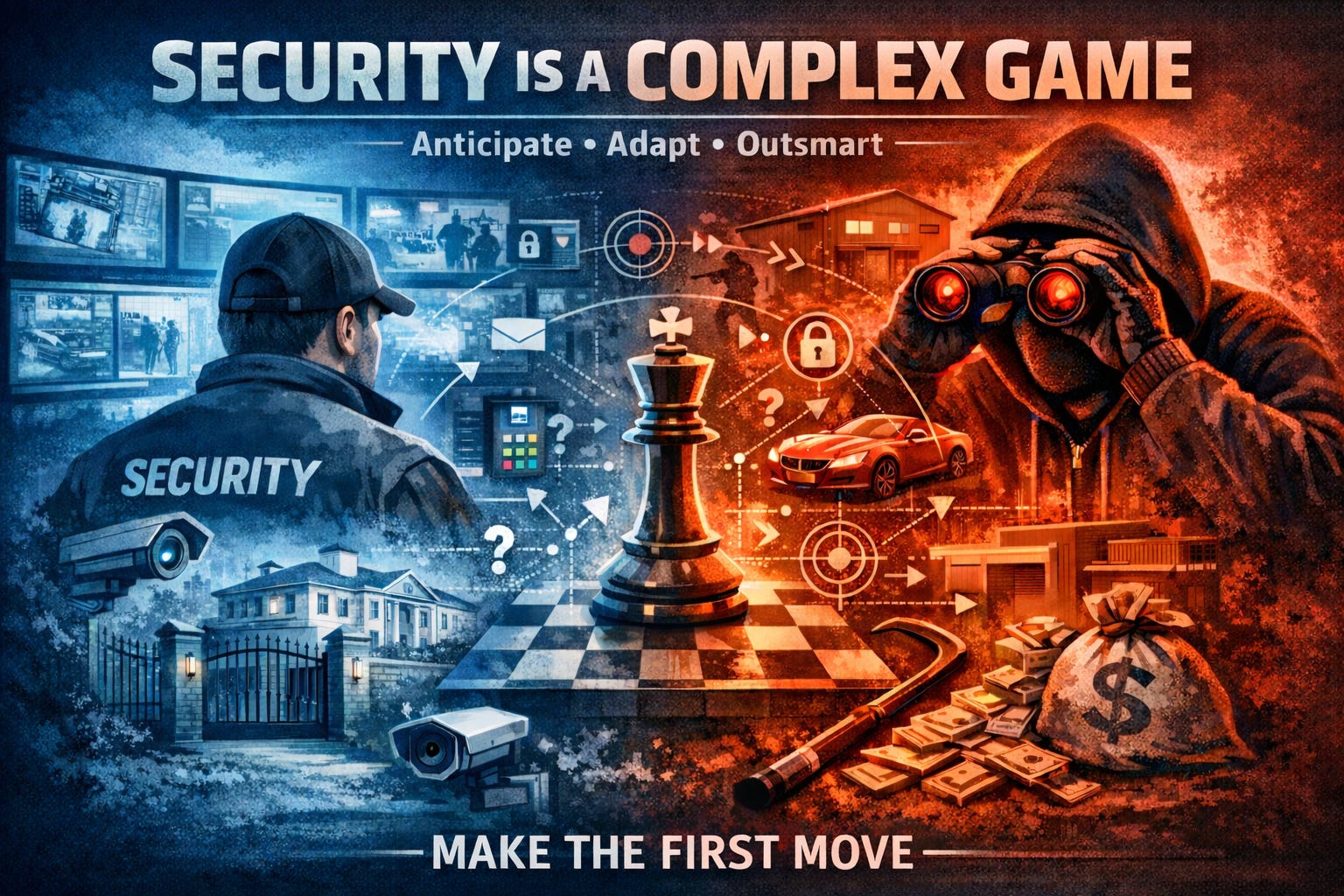
Security is a complex game, played continuously by intelligent actors on both sides.
Organizations that rely on hardware plus hope will keep losing - slowly, quietly, and expensively.
Organizations that apply physical security modeling, measure performance, and think strategically make the first move in creating an effective, efficient, dynamic, and long-lasting physical security program.
S6RG is at the forefront of modern physical security modeling—applying rigorous, game-theoretic risk analysis to real-world environments using proven methodologies, validated performance metrics, and state-of-the-art AI-enabled technologies. We help clients move beyond reactive security toward measurable system effectiveness, defensible decision-making, and true risk reduction. If you are ready to treat physical security as a strategic discipline rather than a checklist, contact us at info@s6rg.net