


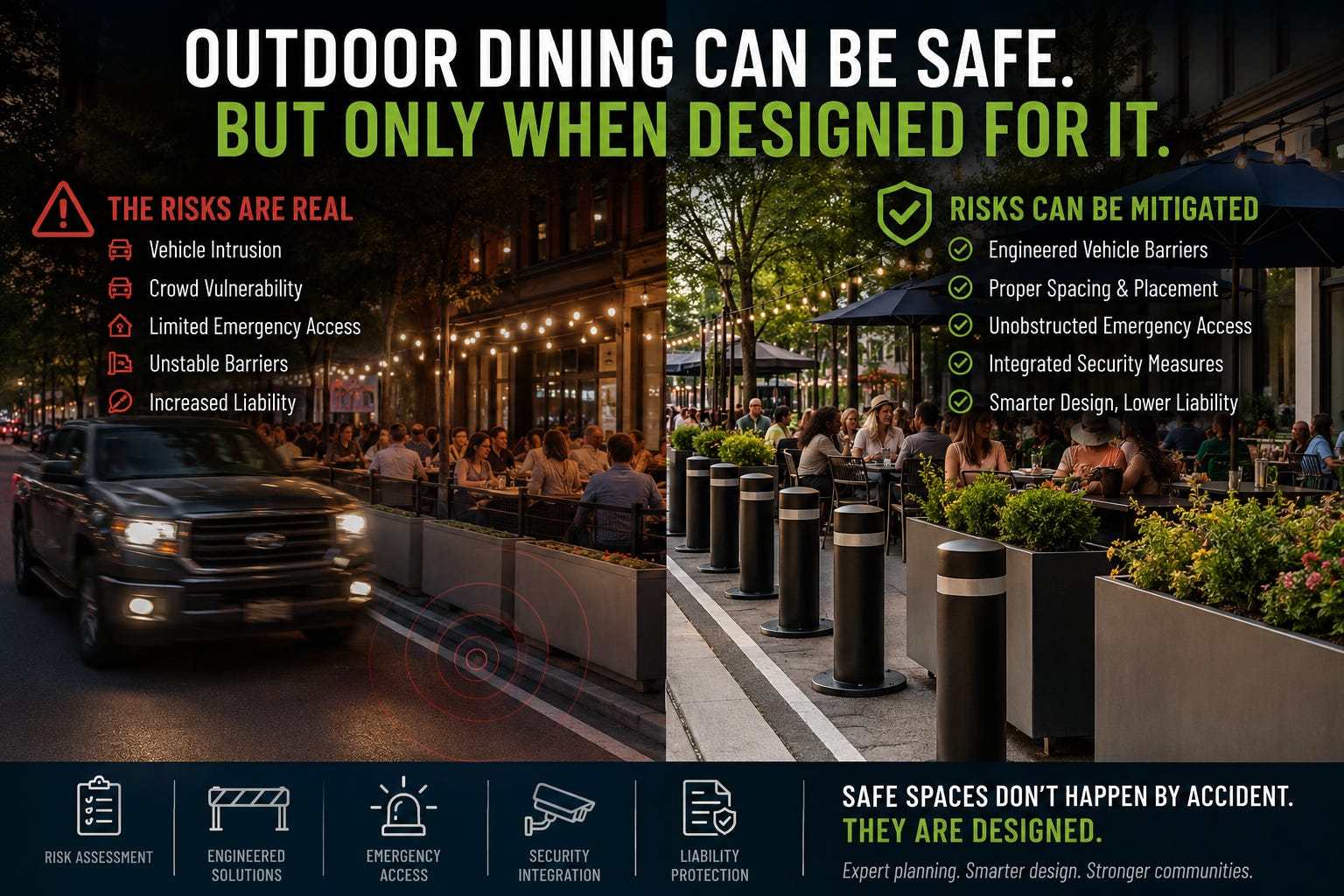
Outdoor dining has become a key feature of modern downtowns. It gained popularity before COVID, peaked during the pandemic, and now many U.S. communities are working to make it more permanent. My town, Summit, NJ, is no different. There’s broad agreement that it’s a good idea after experiencing it during COVID, but because it’s seasonal, the economic benefits are clear while safety and security concerns are less certain. This has led to disagreements that are perhaps necessary rather than unnecessary.
What began as an emergency response during the pandemic has evolved into lasting changes to streets, sidewalks, and public spaces nationwide. In many areas, the outcomes have been very positive. Restaurants have expanded seating, downtowns have become livelier, and residents have welcomed a more pedestrian-friendly atmosphere.
Yet beneath the atmosphere and aesthetics lies a reality that many municipalities, property owners, and business operators still overlook. Outdoor dining creates an entirely new risk environment—one that introduces safety, security, engineering, and liability challenges that do not exist inside a traditional building.
The issue is not that outdoor dining is inherently unsafe. Rather, many outdoor dining areas and concepts were implemented quickly and, in some cases, have remained in place without the level of engineering analysis, security planning, or operational review typically associated with public infrastructure. What often appears to be a simple collection of tables, planters, and decorative barriers can pose a surprisingly complex public-safety challenge.
A Different Kind of Environment
Restaurants are traditionally designed to separate people from hazards. Walls, structural elements, controlled entrances, fire protection systems, and setbacks from traffic all contribute to a relatively predictable environment.
Outdoor dining removes many of these protections.
Today, patrons may find themselves seated just a few feet from moving traffic, including delivery vehicles, rideshare activity, bicycles, scooters, emergency vehicles, and large crowds. In some cases, dining areas occupy former parking lanes or entire streets, with little more than decorative barriers separating diners from intersecting, fully open roadways.
This shift fundamentally changes the risk profile of the space.
The most obvious concern is vehicle intrusion. Although incidents of vehicles entering pedestrian spaces remain relatively uncommon, the consequences can be catastrophic when they occur. Whether caused by driver error, medical emergencies, intoxication, mechanical failure, or intentional acts, vehicles carry an extraordinary amount of destructive force.
Engineers assess that force using kinetic energy, which increases exponentially with vehicle speed. A relatively small increase in speed can dramatically increase impact forces. This is why a barrier that appears substantial to the public may offer little meaningful protection against a vehicle impact.
Many outdoor dining installations rely heavily on visual cues rather than on engineered performance. Large planters, decorative fencing, wooden structures, and movable barriers often create the perception of safety without providing meaningful impact resistance. Many of these features were never designed, tested, or intended to stop a moving vehicle.
The Difference Between Decorative and Protective
One of the most common misconceptions about outdoor dining safety is that anything heavy must be protective.
Unfortunately, that is not always true.
A decorative planter weighing several hundred pounds may seem capable of stopping a vehicle. However, impact performance depends on far more than weight alone. Foundation design, anchorage, reinforcement, structural connections, soil conditions, and vehicle approach angles all influence whether a barrier can perform its intended function during an impact.
This is why security engineers and protective design professionals rely on crash-tested systems rather than on assumptions.
In the United States, vehicle barriers are often evaluated using standards such as ASTM F2656, which assesses a barrier’s ability to stop vehicles of specified weights traveling at specified speeds. More recently, ASTM F3016 has become increasingly relevant for protecting storefronts, sidewalks, and other pedestrian environments from impacts by low-speed vehicles.
These standards do not simply assess whether a barrier survives a collision. They also evaluate how far a vehicle penetrates beyond the barrier after impact, which is often the critical factor in protecting people.
The distinction matters because many outdoor dining installations incorporate elements that have never undergone formal testing. While they may improve aesthetics and help define a space, they may contribute little to actual protection.
The Engineering Most People Never See
Effective outdoor dining protection is rarely seen.
The public notices attractive landscaping, decorative street furniture, lighting, and comfortable seating. What they do not notice are the engineering calculations that determine whether those features can withstand impact forces, maintain emergency access, and support safe operations over time.
Even something as simple as bollard spacing illustrates this complexity.
Place bollards too close together, and accessibility suffers. Place them too far apart, and vehicles may be able to pass between them. The optimal spacing depends on numerous factors, including vehicle dimensions, approach angles, pedestrian circulation, accessibility requirements, and the specific threat.
The same complexity lies beneath the surface. Many high-performance barriers require substantial foundations extending several feet below grade. Utility conflicts, drainage systems, frost-protection requirements, and underground infrastructure must all be considered before installation.
What appears to be a simple streetscape improvement often requires extensive coordination among engineers, planners, architects, public works officials, emergency responders, and security professionals.
Emergency Access Cannot Be an Afterthought
One of the most overlooked aspects of outdoor dining design is access for emergencies.
Street closures and protective barriers may improve pedestrian safety but pose challenges for fire departments, EMS agencies, and law enforcement. Emergency vehicles require sufficient roadway width, turning radii, and access points to operate effectively during critical incidents.
A design that works well on a pleasant Saturday evening may pose significant problems during a structural fire, a medical emergency, or a mass-casualty incident.
This challenge becomes particularly acute in older downtown districts, where roadway widths were already constrained long before the advent of outdoor dining.
Balancing protection and accessibility requires careful analysis. Too little protection leaves patrons vulnerable, while excessive infrastructure in the wrong location can impede emergency operations. Achieving the proper balance requires both engineering expertise and operational understanding.
Security Risks Extend Beyond Traffic
While vehicle intrusion often receives the most attention, it is only one part of the overall risk landscape.
Outdoor dining areas are highly public, highly visible, and often densely populated. These characteristics create opportunities for theft, disorderly conduct, assaults, vandalism, and other security incidents. The open nature of these environments can also complicate surveillance, access control, and emergency response.
Good design can significantly reduce many of these risks. Proper lighting improves visibility, and camera systems enhance situational awareness. Thoughtful site layouts eliminate blind spots and increase natural surveillance. Staff training and emergency procedures further strengthen resilience.
The most effective security measures often go unnoticed because they are seamlessly integrated into the environment rather than imposed upon it.
Weather Is a Design Problem Too
Another commonly overlooked issue is the weather.
Temporary structures, tents, umbrellas, partitions, and decorative elements may perform well under normal conditions but can become hazards during severe weather. High winds can turn unsecured objects into dangerous projectiles. Heavy rain can cause drainage issues and create slip hazards. Snow and ice introduce additional structural and operational concerns.
Even seemingly minor decisions—such as how an umbrella is anchored or how a temporary enclosure is secured—can carry significant safety implications.
What appears to be a simple outdoor seating area may require structural analysis, electrical review, drainage evaluation, and emergency operating procedures.
The Liability Question
As outdoor dining shifts from a temporary measure to a permanent feature of the built environment, expectations are evolving.
Property owners, municipalities, and business operators increasingly face scrutiny over whether foreseeable hazards were properly evaluated and addressed. After a serious incident, the question is rarely whether a risk could have been eliminated entirely. Instead, the focus often shifts to whether reasonable steps were taken to identify, assess, and mitigate foreseeable hazards.
That distinction is important.
No environment can ever be completely risk-free. However, organizations that fail to conduct appropriate assessments, implement reasonable safeguards, or engage qualified professionals may face difficult questions following an incident.
Safe Outdoor Dining Doesn’t Happen by Accident
Outdoor dining can be vibrant, welcoming, and highly successful. Many communities have shown that these spaces can enhance quality of life, strengthen local economies, and create memorable public experiences.
But successful outdoor dining is rarely the result of luck alone.
Behind the most effective installations are countless decisions spanning engineering, security, emergency management, operations, and risk management. The barriers are properly designed. Emergency access has been considered. Vehicle pathways have been evaluated. Security measures have been integrated thoughtfully rather than added as an afterthought.
The challenge is that most of this work remains invisible to the public.
People notice the atmosphere, the food, and the overall experience.
What they do not see is the planning that makes those experiences possible.
That planning is what transforms outdoor dining from a temporary gathering space into a truly safe public space.
About S6RG
S6RG is an independent physical security and risk advisory firm serving organizations, institutions, developers, and private clients that require sophisticated guidance on physical security, protective risk management, and organizational resilience. We work with select clients across the commercial, retail, residential, mixed-use, healthcare, educational, and nonprofit sectors, providing security assessments, protective design, strategic planning, and security program development.