


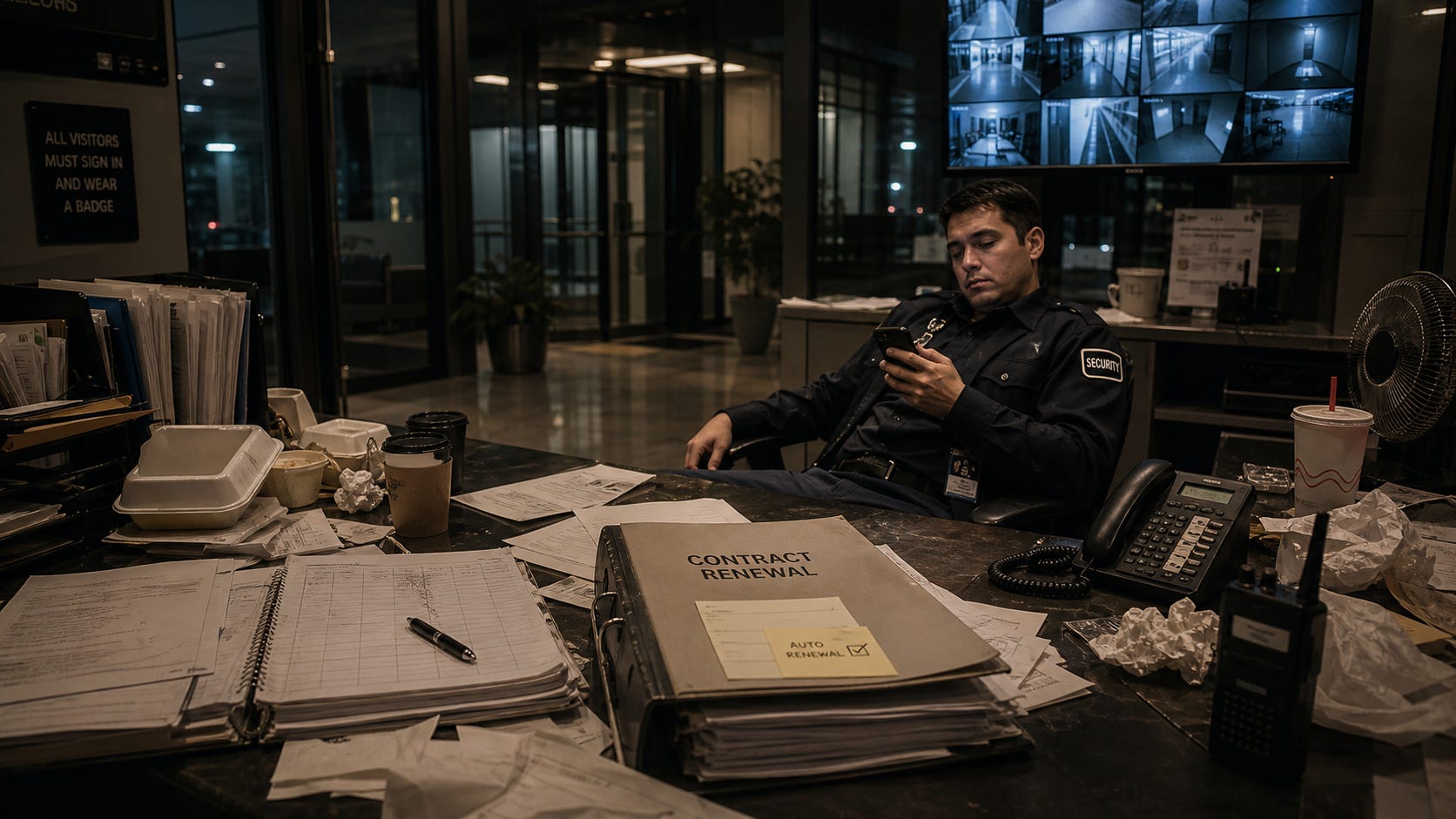
A guard contract is often put in place at a particular moment: a new building opening, a prior incident, a tenant demand, an insurance concern, a board directive, a compliance issue, or a leadership decision made years earlier. The program then becomes part of the operating budget. Invoices arrive. Hours are approved. Posts are filled (usually). The contract renews. Everyone assumes the program is doing what it was designed to do.
But is it?
For many property owners, managers, institutions, and businesses, the honest answer is: no one really knows.
That is a problem.
A guarding program should be viewed as an operational system, not a static expense. Regularly review staffing, post orders, supervision, training, billing, technology, incident reporting, emergency response, quality assurance, and performance. Without this, the organization risks overspending or relying on a program that appears sufficient but fails when needed most.
The Cost of “We’ve Always Done It This Way”
Security guarding programs become less efficient and less effective over time.
A post that made sense five years ago may no longer be necessary. A lobby position may cover the wrong hours. A vehicle patrol may follow predictable rounds that offer little deterrent value. A 24/7 post may persist because no one wants to be responsible for eliminating it. Conversely, a property may be understaffed during periods of highest actual risk because the schedule was designed around convenience rather than exposure. In some cases, even modest attempts to review or rebid a guarding contract are met with pressure, defensiveness, or quiet intimidation from providers who have grown far too comfortable with the account and show up to make you “an offer you can’t refuse.”

This is how security programs drift: they become disproportionately costly, operationally stale, and less effective.
They drift away from the threat environment. They drift away from business operations. They drift away from tenant expectations. They drift away from what ownership thought it was buying.
The result is often an expensive, familiar program that is poorly aligned with current risk. That should make owners and senior managers uncomfortable.
When Was the Last Time You Looked at the Hours?
Billable hours are where small assumptions become large expenses.
Extra hours, shift differentials, overlap, holiday billing, minimum shifts, overtime leakage, and poorly managed coverage can add thousands to costs annually, with larger portfolios seeing even higher totals.
The issue is not simply whether the invoices are mathematically correct. The more important question is whether the hours being purchased are necessary, properly deployed, and tied to defined protective outcomes.
Is the property paying for presence, performance, or habit?
A thorough review should examine the relationship between post coverage, incident patterns, building activity, visitor volume, tenant operations, loading dock activity, parking demand, public access, prior calls for service, and foreseeable risks. Guarding hours should be defensible, explainable, and connected to operational needs.
If no one can explain why a particular post exists, why it operates during those hours, what it is expected to accomplish, and how performance is measured, it should be reviewed and possibly eliminated.
Staffing Is Not Strategy
Many organizations confuse staffing with security.
Having guards on site is not the same as having a security program. A uniformed officer at a desk does not automatically deter. A patrol vehicle does not automatically reduce risk. A sign-in sheet does not automatically control access. A camera monitor does not automatically enable detection, assessment, or response.
The value of guarding depends on design.
What is the officer expected to observe? What decisions can the officer make? Which incidents require escalation? What technology supports the post? What are the response expectations? What authority does the officer have? What training has the officer received? What happens when the officer is absent, distracted, overwhelmed, or unsure?
A well-designed guarding program begins with the function, not the headcount.
Sometimes the answer is more staff. Sometimes it is less staff. Sometimes it is different staff. Sometimes the better solution is a combination of physical design, access control, video analytics, remote monitoring, visitor management, lighting, policy, and targeted patrols.
The objective should not be to buy guards. It should be to manage risk.
Training Cannot Be Assumed
Many guard contracts include language about training. That does not mean the officers assigned to your site are properly trained for your site. In many cases, guards only complete the minimum training required to be licensed.
There is a significant difference among general licensing, basic orientation, and site-specific readiness. Guards assigned to residential high-rises, office buildings, healthcare facilities, schools, mixed-use developments, industrial sites, houses of worship, and retail properties face very different conditions and expectations. They need to understand the environment, people, escalation pathways, emergencies, and risks.
Can the officers explain the site’s emergency action plan? Do they know how to respond to a medical emergency, workplace violence incident, fire alarm, suspicious package report, domestic dispute, protest activity, active assailant threat, utility failure, or access control breach?
Do they know whom to call, what to document, when to intervene, when not to intervene, and how to preserve video, logs, and incident evidence?
If the answer is unclear, the training program is deficient.
Security officers are often the first visible representatives of a property’s security posture. In a serious incident, they may also serve as central witnesses. Their actions, inactions, reports, communications, and training records may later be reviewed by insurers, attorneys, regulators, ownership, tenants, the public, and even judges and juries.
Competitive Bidding Is Not Just About Price
Many organizations put guarding services out to bid only when they are dissatisfied with the provider or under pressure to reduce costs. That is too narrow.
Competitive bidding is more than a purchasing process; it tests the entire security program. Proper management reveals whether the scope is unclear, post orders are outdated, supervision is weak, wages are too low, technology is underused, or the incumbent is coasting.
But a poorly written request for proposal can create its own problems. If the scope is vague, bidders will price their assumptions. If the evaluation is driven primarily by hourly rate, the client may get exactly what it paid for: low wages, high turnover, weak supervision, minimal training, and limited accountability.
The best bid process begins before the RFP, with an independent review of the program, outcomes, required positions, qualifications, supervision model, reporting, and performance measurement. Otherwise, the organization is not buying better security. It is merely rebidding the same, probably obsolete, assumptions.
The Risk of Poor Documentation
Guarding programs are often judged after something goes wrong. At that point, documentation, post orders, training records, incident reports, daily activity logs, corrective action records, staffing rosters, visitor logs, video retention practices, and emails and contract documents all matter.
A property may believe it had a reasonable security program, but if the documentation is incomplete, inconsistent, outdated, or contradictory, that belief may be difficult to defend.
This is crucial for properties with public access, residents, parking, past incidents, disorder, tenant complaints, crime trends, vulnerable groups, or security call history. The security program must be more than performative; it should be thoughtful, well-documented, supervised, and periodically reviewed.
A good program does not need to be perfect. But it does need to make sense.
Technology May Be Changing the Guarding Equation
The guarding model has changed.
Video analytics, access control data, remote guarding, visitor management systems, license plate recognition, emergency communications platforms, mobile reporting, GPS-enabled patrol verification, digital incident management, and real-time operations centers can all influence how staffing should be designed.
This does not mean technology replaces guards in every case. It means guarding and technology should be evaluated together.
A lobby officer monitoring cameras may be less effective than a trained remote operator supported by analytics and clear escalation protocols. A mobile patrol may be more effective when guided by real-time incident data rather than a fixed route. A loading dock post may be unnecessary during certain hours if access control, intercom, video verification, and response procedures are properly designed. A residential property may need more human presence during predictable periods of resident interaction, but less static coverage during low-activity hours.
The right answer depends on the site. The wrong answer is to keep paying for yesterday’s model because no one has challenged it.
Questions Owners and Managers Should Be Asking
A mature review of a guarding program should be direct and practical.
When was the staffing plan last reviewed against actual risk, activity, and incident data? Are the posts still necessary? Are the hours aligned with periods of highest exposure? Are officers properly trained for the specific site? Are post orders current, realistic, and followed? Are invoices reviewed for accuracy, including overtime, holidays, special coverage, and contract compliance? Is the provider held to measurable performance standards? Has the contract been competitively bid in a disciplined manner? Are wage rates sufficient to attract the caliber of officer the property expects? Is technology used to reduce waste and improve performance? Are incident reports complete, timely, and useful? Is there evidence that the program is reducing risk?
These are not academic questions. They directly address cost, performance, liability, and duty of care.
The Security Guarding Audit
For organizations unsure whether their guarding program still makes sense, the best starting point is an independent security guarding audit.
This is not a vendor sales call. It is not a staffing company proposing to replace the incumbent. It is an objective review of the existing program.
A thorough audit reviews contract structure, billable hours, post coverage, staffing levels, incident history, guard performance, supervision, training, post orders, technology, invoicing, reporting, emergency readiness, and site risk alignment. It identifies effective practices, unnecessary elements, underperformers, overpayments, and vulnerabilities.
Sometimes, the conclusion is that the existing provider performs well, but their scope needs refinement. Other cases require rebidding. Occasionally, reducing static posts and reinvesting in technology, supervision, patrols, or emergency preparedness is best. Sometimes, increasing coverage is necessary if the current program is too thin for the risk.
The point is not to cut guards. The point is to make the program defensible, efficient, and effective.

Familiar Does Not Mean Sound
Security programs can become expensive habits.
A guard sitting at a desk every day creates a sense of continuity. A patrol route creates a sense of activity. A monthly invoice creates a sense that something is being managed. But none of that proves the program is properly designed.
For owners, executives, boards, property managers, and institutional leaders, the question is straightforward:
Does your guarding program still make sense?
If you have not reviewed the staffing model, billable hours, training, post orders, supervision, technology integration, contract structure, and competitive pricing in the last few years, you may not know the answer.
And if you do not know the answer, you may already be carrying more cost — and more risk — than you realize.
S6RG helps property owners, institutions, businesses, and private clients evaluate, redesign, and optimize physical security programs through independent, vendor-neutral security assessments, guarding audits, and protective risk advisory services.