


Home invasions, assaults, and kidnappings do not happen randomly. They occur when opportunity aligns with predictability—and when security systems, despite appearances, fail to work as intended.
The case of Nancy Guthrie highlights a critical and recurring issue: many high-profile, high-net-worth households believe they are protected, yet they are not.
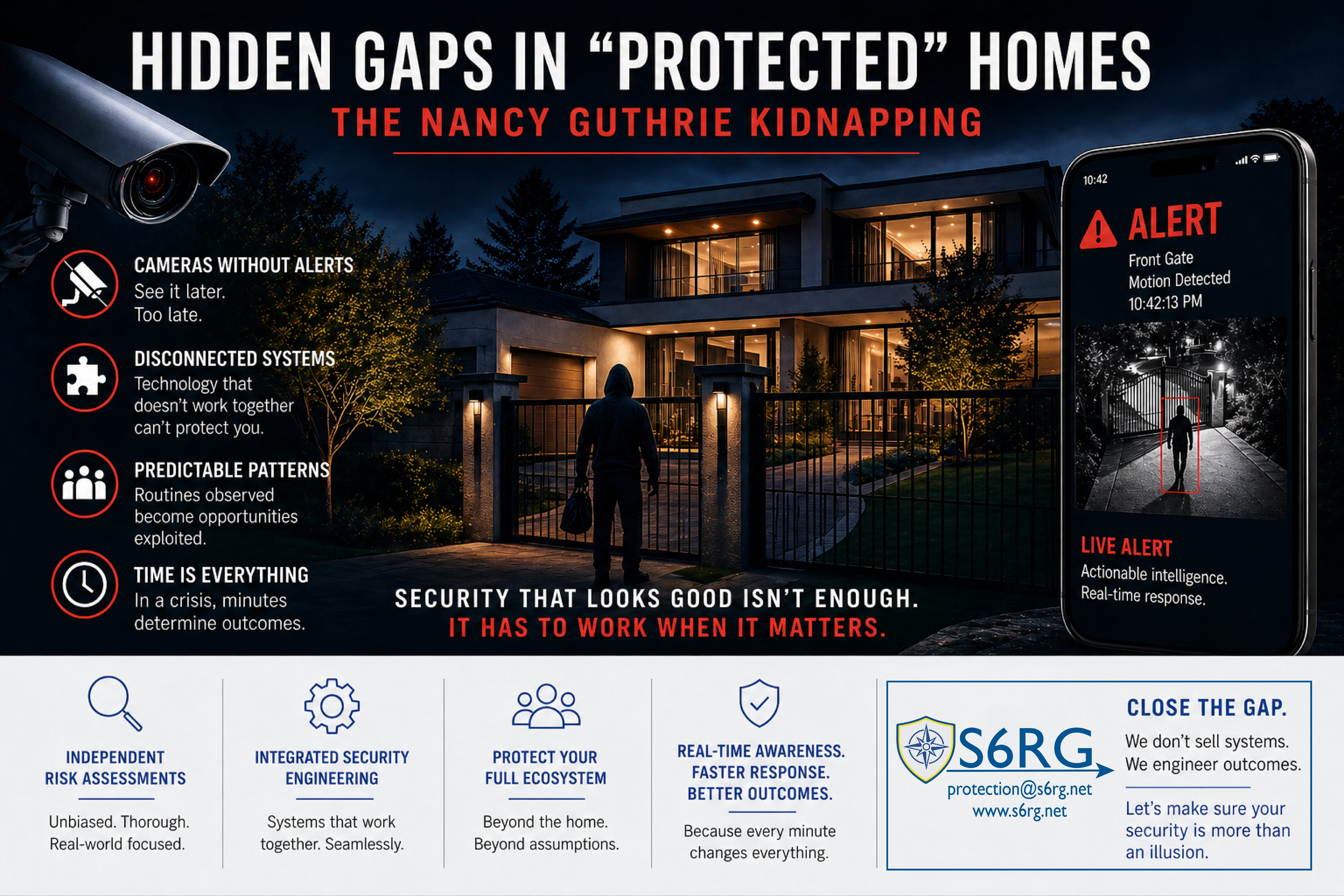
The Illusion of Security
One of the most consequential aspects of this case is not what was missing but what was present yet ineffective.
Cameras were installed, yet coverage appears insufficient. More importantly, there were no active subscriptions to enable real-time analytics, alerting, or response. The system functioned as little more than a passive recording tool, leaving fragmented footage available only after the incident.
Without active monitoring and properly configured alerts, modern residential security systems are significantly degraded. They lack real-time detection, escalation capabilities, and immediate access to actionable intelligence. In time-sensitive events such as abductions, this distinction is critical. The difference between prevention and post-incident investigation is often measured in minutes.
This was not a technological failure—it was a failure of configuration, integration, and strategy.
Security Without Strategy
Homeowners routinely invest significant effort in designing and optimizing their properties—carefully evaluating materials, layouts, and aesthetics. Security, however, is often treated differently. Decisions are frequently deferred to vendors whose incentives are tied to selling equipment rather than to solving risk.
As a result, many homes have technology that creates the appearance of protection but lacks operational effectiveness. Cameras are installed but poorly configured. Access control exists, but is not integrated. Alerting, escalation, and response protocols are undefined.
This is not a partial solution—it is security theater.
The Broader Exposure
A critical oversight in many security programs is the narrow focus on the primary residence.
For high-profile individuals, the threat rarely presents itself directly. Instead, attackers exploit the broader ecosystem—family members, routines, and secondary locations that are less protected and more predictable. Parents living independently, college-age children, siblings, and extended family members are often softer targets. They are not separate from the risk; they are frequently the pathway to it.
Compounding Failures
Incidents like this are rarely the result of a single weakness. They stem from a combination of incomplete systems, predictable behavior, and insufficient planning.
Technology is installed but not actively managed. Daily routines create observable patterns. There is no defined response framework—no shared understanding of warning signs, roles, or actions during stress. Without real-time situational awareness, incidents go undetected until intervention becomes significantly more difficult.
Time as the Deciding Factor
In any abduction or coercion scenario, time is the most valuable resource.
Early detection enables intervention. Real-time awareness enables decision-making. Speed determines the outcome.
A camera system without alerts does not deter or protect—it only documents. By the time footage is reviewed, the most critical window has already closed.
What Effective Security Would Look Like
A properly engineered security program is designed to operate in real time. It integrates detection, communication, and response into a cohesive system.
Monitoring and alerting must be active and intelligent, delivering actionable information to the right people without delay. Systems must be integrated so that cameras, alarms, and access controls operate as a unified platform rather than as isolated tools. Protection must extend beyond a single property to encompass the individual’s or family’s full exposure network.
Equally important is pathway analysis—understanding how an attacker would identify, surveil, and approach a target—and then systematically disrupting that pathway before it is executed.
Where Most Approaches Fail
The gap between installed technology and operational security is where most failures occur.
This is where a firm like S6RG positions itself differently. The focus is not on installing systems but on engineering outcomes—ensuring that what exists actually works in real-world conditions. That means identifying hidden gaps, activating dormant capabilities, integrating systems, and building response frameworks that perform under pressure.
Most importantly, it means eliminating silent failures—such as inactive subscriptions or unmonitored systems—that foster false confidence while leaving real vulnerabilities exposed.
Final Thought: The Risk of Being “Almost Secure”
The most dangerous condition is not the absence of security—it is the illusion of security.
A camera without alerts.
A system without monitoring.
A plan that covers only part of the risk.
These are not incomplete solutions; they are predictable failure points.
The lesson from the Nancy Guthrie case is not simply that something went wrong. It is that earlier detection—and potentially disruption—could have been achieved much more easily if the system had been designed to function as intended.
That is the difference between security that looks effective… and security that actually is effective.
A Better Approach
S6RG exists to close this gap.
We work with high-net-worth individuals and families to identify where protection appears to exist—and where it fails under real-world conditions. Our assessments are independent, discreet, and grounded in how threats develop and unfold.
We do not sell products. We design outcomes.
Through our Protective Risk Framwork™ architecture, we ensure your systems are active, integrated, and aligned with real risk—not assumptions. We extend protection beyond a single residence to your entire exposure network and build the detection, awareness, and response capabilities needed to act in time—when it matters most.
Because in this space, the difference isn’t technology. It’s whether it works.
Contact us at : protection@s6rg.net of visit our website www.s6rg.net