


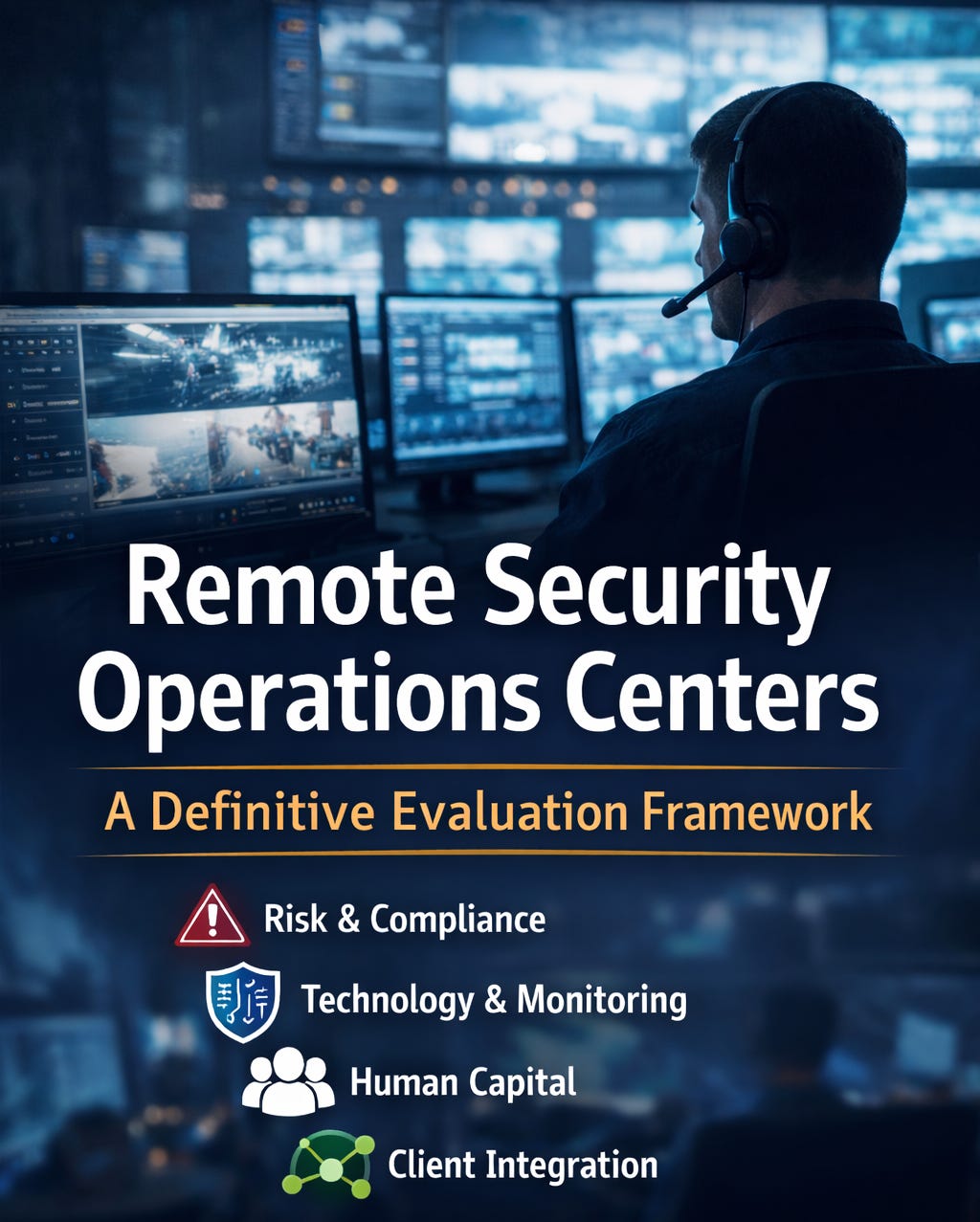
Once reliant on static guards and local alarms, modern security programs now integrate advanced sensors, video analytics, and Remote Security Operations Centers (RSOCs) that provide real-time monitoring and response.
Remote guarding has significantly improved basic physical security, but adoption in more complex environments remains inconsistent. This is often due to noncompliant, ad hoc operations centers that increase risk. However, this trend is shifting, and we are leading this transformation.
Not all RSOCs offer the same level of quality, compliance, privacy, or effectiveness.
An attractive website or low price does not ensure compliance, capability, or trustworthiness. In high-risk or high-value settings such as luxury estates, commercial properties, industrial sites, or regulated infrastructure, a poorly managed RSOC can increase liability and risk.
If you are considering remote guarding for your security program, whether simple or complex, look for these RSOC features to enhance protection, reduce risk, and control costs:
1. Governance, Compliance & Accreditation
A credible RSOC operates within a formalized governance framework that ensures legal compliance, data protection, and operational discipline.
Key Elements:
Regulatory Compliance (where applicable):
Kari’s Law and RAY BAUM’s Act compliance for emergency calling and location accuracy.
NG911 readiness and integration for faster emergency dispatch.
Privacy regulations (GDPR, HIPAA, state privacy laws).
UL standards such as UL 827 (Monitoring Stations) and UL 2900-2-3 (Cybersecurity).
For critical infrastructure: MTSA, TWIC, or other sector-specific mandates.
Third-Party Accreditation:
UL certification (827A or 1981 for video monitoring).
ISO 27001 or SOC 2 compliance for information security.
Participation in recognized industry bodies (e.g., TMA, SIA)
Written Policies & SOPs:
Documentation on data retention, incident reporting, escalation paths, and chain of custody for evidence.
Regular third-party audits or internal compliance reviews.
Pro Tip: Ask to see proof of certification - not just a marketing claim. A legitimate RSOC should be able to provide a current certificate or audit summary.
2. Infrastructure Resilience & Redundancy
RSOCs must function as critical facilities. A credible center maintains layered redundancy to ensure continuous monitoring during power, network, or environmental disruptions.
Key Elements:
Physical Facility:
Hardened building envelope with controlled access.
Redundant power (UPS + generator).
Redundant fiber or satellite connectivity (e.g., Starlink backup).
Fire suppression, HVAC redundancy, and environmental monitoring.
Technical Infrastructure:
Dual or distributed RSOCs (geo-redundancy).
Hot failover capabilities for uninterrupted operations.
Secure cloud architecture with zero-trust access control.
Operational Resilience:
Documented business continuity and disaster recovery plans.
Regular failover testing and incident simulations.
Pro Tip: A reliable RSOC should never lose operational capability. Ask how they manage catastrophic failures at their primary facility.
3. Cybersecurity and Data Protection
Remote guarding relies on sensitive video streams, control systems, and personal data. A breach may result in litigation, reputational harm, or physical security risks.
Key Elements:
Secure Networks: Encrypted video and data transmission (TLS 1.2 or higher), segmented networks, intrusion detection systems.
Identity Management: MFA for all operators, role-based access, strong credentialing.
Cyber Certification: UL 2900-2-3 or SOC 2 Type II audits, SIEM monitoring.
Incident Response: Defined protocols for cyber incidents, regular penetration testing, and third-party audits.
Pro Tip: A simple statement such as “We have firewalls” is insufficient. Ask about UL 2900-2-3 certification and review their cybersecurity incident response plan.
4. Technology Stack and Interoperability
An RSOC’s effectiveness relies on its ability to integrate, analyze, and act on data from multiple sources, such as cameras, sensors, alarms, access control systems, drones, and AI.
Key Elements:
Open Architecture: Ability to integrate with various VMS/PSIM/ACS platforms.
AI & Video Analytics: Behavior analysis, perimeter detection, thermal, and object classification.
Interoperability: AVS-01 compliance for standardizing alarm signals.
Remote Access & Control: Secure operator control of PTZ cameras, intercoms, and gates.
Pro Tip: Ask for a live demonstration with your site’s actual systems, not just a canned demo environment.
5. Human Capital: Training, Vetting, and Culture
Technology is only as effective as the people who operate it. RSOC operators must be highly trained, thoroughly vetted, and supported by strong leadership and quality assurance programs.
Key Elements:
Vetting: Background checks, drug screening, and security clearances where applicable.
Training: AVS-01 operational readiness, de-escalation tactics, emergency communications, situational awareness.
Ongoing Professional Development: Regular refresher training and scenario-based exercises.
Culture: Low turnover, professional demeanor, and well-defined leadership structure.
Pro Tip: Ask about their operator-to-supervisor ratio and QA program. High turnover is a red flag.
6. Monitoring, Detection, and Response Protocols
A modern RSOC does more than passively monitor cameras. It implements structured, escalating response protocols.
Key Elements:
Proactive Monitoring: Real-time alerts, AI-assisted detection, geofenced trigger zones.
Response Playbooks: SOPs for incidents—intrusion, trespass, fire, vehicle theft, loitering, etc.
Integrated Communications: Direct links to law enforcement, private responders, or on-site personnel.
Documentation: Automated incident reports, audit trails, and evidentiary-quality recordings.
Pro Tip: Evaluate their response time targets and escalation protocols. Request a review of recent anonymized incident logs.
7. Compliance with Privacy, Liability & Legal Considerations
An inadequately managed RSOC can expose clients to significant legal risk. Ensure their program aligns with privacy regulations and evidentiary standards.
Key Elements:
Privacy Protection: Compliance with state privacy laws, proper signage, and masking of sensitive areas.
Evidence Handling: Secure storage, chain of custody protocols, legal review readiness.
Insurance & Indemnification: Errors and omissions (E&O), cyber liability, professional liability.
Pro Tip: Require written evidence-handling policies and ensure their insurance covers RSOC operator actions.
8. Client Integration, Reporting, and Transparency
An RSOC should operate as an extension of your security program, providing transparency rather than operating as a black box.
Key Elements:
Client Portal: Real-time status dashboards, incident logs, and reporting.
Customizable Escalation: Ability to tailor who gets called and when.
Reporting Cadence: Daily, weekly, and monthly summaries with trend analysis.
Transparency: Access to audit trails and video for review.
Pro Tip: A professional RSOC offers transparency and accountability, not excuses.
9. Metrics, QA, and Continuous Improvement
Security is a measurable discipline. The best RSOCs operate with Key Performance Indicators (KPIs) and continuous improvement cycles.
Key Elements:
Leading Metrics: Alarm response times, detection rates, escalation accuracy.
Lagging Metrics: Incident closure rates, false alarm reduction, law enforcement response outcomes.
QA & Audit: Regular internal audits, third-party assessments, mystery incidents.
Client Feedback Loops: Post-incident reviews and quarterly performance meetings.
Pro Tip: If an RSOC does not track performance metrics, it cannot demonstrate its value.
10. Strategic Fit: Alignment with Your Risk Profile
Even a world-class RSOC may not be suitable if it does not align with your operational, regulatory, or risk requirements.
Key Elements:
Property or asset type (estate, commercial, regulated site).
Level of integration needed (on-site responders vs. remote only).
Regulatory oversight (e.g., MTSA, HIPAA, PCI-DSS).
Long-term service scalability and flexibility.
Pro Tip: Do not simply purchase a service; build a partnership. Choose a provider whose program evolves with your risk profile.
Conclusion
Remote guarding can significantly enhance security and reduce costs, but only when supported by a professional RSOC. A low-cost, uncertified monitoring center may increase liability and create a false sense of security.
Use this framework to evaluate vendors: request documentation, demonstrations, and evidence rather than relying solely on sales claims.
Ready for a deeper look into Remote Guarding? Contact us at info@s6rg.net