


Charlie Kirk’s assassination was a horrible crime and, in my view, a preventable one. While I’ve never bought into the numerous conspiracy theories surrounding his death, I have always wondered what his security team was doing in the days and weeks leading up to the event, particularly given the threat environment surrounding him.
This notice of claim, announced today (Charlie Kirk’s family wants to sue Utah Valley University), raises some important questions.
There is certainly plenty to examine regarding Utah Valley University’s security planning, and the Kirk family’s allegations deserve to be evaluated on the evidence. But another side of this shouldn’t be ignored:
Charlie Kirk’s protective team had its own independent responsibility to determine whether the environment was sufficiently secure for him to take that stage.
The venue controls its property. The university controls its police resources. But a protective team cannot outsource responsibility for protecting its principal.
The apparent timeline is particularly concerning.
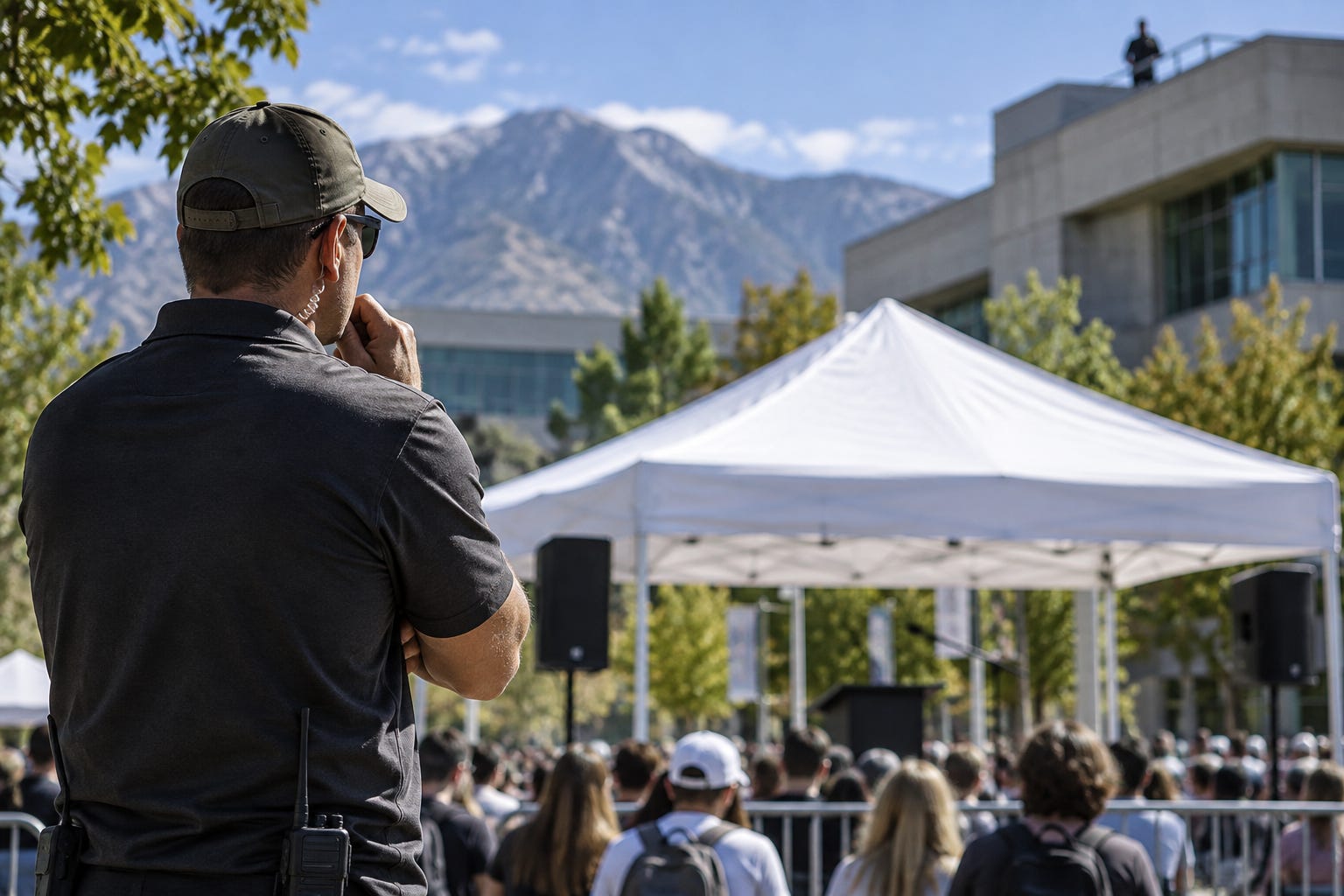
Kirk’s security chief, Brian Harpole, has said that just two days before the event he contacted UVU Police Chief Jeffrey Long after receiving a message from the student group indicating that students apparently had roof access near where Kirk would be speaking.
Harpole asked that the access be controlled or that his team be allowed to place someone there. According to Harpole, Long responded:
“I got you covered.”
Two days before?
And the concern apparently originated with the student group?
That immediately raises a much larger question: What did the protective advance consist of before that message arrived?
Even more concerning is the notice’s allegation that UVU did not conduct an adequate risk assessment or develop an appropriate security plan before approving the courtyard location.
UVU absolutely had responsibilities of its own. But where was the protective team’s assessment?
Had Kirk’s team conducted an on-site advance? Had it documented the surrounding elevated positions and sightlines? Had it identified vulnerabilities, responsibilities and required mitigations with UVU? Had it established minimum conditions that had to be satisfied before Kirk arrived?
If that work did not occur, it would represent a profound failure of protective planning.
The same applies to emergency medical response. The family’s notice alleges that first responders were not immediately available and that Kirk ultimately had to be transported to the hospital in a private vehicle.
For someone with Kirk’s profile and threat exposure, medical response, trauma care, emergency extraction and transportation should have been explicitly planned, coordinated and verified in advance — whether provided by public agencies or contracted resources.
This is basic protective-security management.
For a nationally known figure appearing outdoors in a courtyard surrounded by buildings, elevated positions and sightlines should have been among the first considerations — along with access routes, ingress and egress, crowd control, emergency extraction, communications, medical response, law-enforcement responsibilities and contingency plans.
That work belongs in a structured protective advance completed well before the principal arrives — not something that surfaces almost incidentally 48 hours before the event.
UVU may ultimately bear significant responsibility. Its police chief acknowledged after the shooting that the department had failed to get all of its bases covered, and subsequent reporting has identified significant gaps in the security operation.
But none of that eliminates the protective team’s responsibility.
If Kirk’s team determined that critical elevated positions had to be secured, those protective measures should have been physically verified before Kirk entered the environment.
An assurance of “I got you covered” is not verification.
And if critical protective measures could not be verified, the team still had options:
Move the event. Move it indoors. Change Kirk’s position. Add resources. Delay his arrival. Establish additional protective conditions. Or recommend that he not take the stage.
The protective team owns that professional go/no-go recommendation.
That’s one of the hardest responsibilities in executive protection: being willing to tell the principal, organizer, or client that the conditions are unacceptable.
This notice of claim may ultimately expose serious failures by UVU. But it also raises serious questions about Kirk’s protective operation.
This entire security effort appears to have been far too loose for the threat environment surrounding Charlie Kirk.
A serious examination of what happened should therefore look in both directions: what UVU failed to do and what Kirk’s protective advance consisted of; what his security team identified; what it verified; what remained unresolved; what it communicated to Kirk and TPUSA leadership; and ultimately, why the event was allowed to proceed under those conditions.